


Prior to becoming an Egin Peer Mentor, Elfed worked for the Energy Saving Trust and the Welsh Government, supporting local authorities and other organisations in their efforts to decarbonise transport. Here he discusses how the UK’s transport sector might meet the 2050 zero carbon target.
In part 1, we discussed how Electric Vehicles reduce carbon, the government’s plan for 2050, and what community groups should consider in terms of transport.
The Transport Hierarchy
So far we have explored some pretty technical details about the relative merits of switching to electric vehicles and why this is part of the government’s decarbonisation strategy.
It should also be clear that switching straight to EV while maintaining current usage patterns for road transport is not the most sustainable or effective option. It is important to implement changes to how people travel on the roads and to provide the means and resources to make these changes possible.
Transport systems can be listed in terms of their impact, as in this diagram:

Individual electric vehicles are actually quite far down in the transport hierarchy. Addressing public transport and active travel options has a number of environmental, social and health benefits which is why it is a key element of the Welsh Government’s approach to decarbonising the road transport sector.
The Welsh government has pledged to spend £60 million on developing a safe network for walking and cycling to increase active travel from the estimated 27% share of modes of transport to at least 35% by 2040.
The Welsh Government is also planning to invest in public transport by modernising rail networks, improving core train lines and developing bus hubs in rural areas. The Welsh Government’s targets on increasing the use of low emission vehicles (particularly in the public sector fleet) and improving charging infrastructure are in line with these other strategies.
A brief word on alternative fuel options
Some other options exist when looking at decarbonising transport. These include hybrid cars, hybrid cars that can be plugged in, LPG gas, HVO (fuel made from waste cooking oil) and biofuels, hydrogen and synthetic fuels. Most of these technologies already exist on the roads, although vehicle numbers are relatively small, a situation that itself inhibits consumption growth due to lack of infrastructure and supply.
In assessing the viability of these fuels going forward, it’s a mixed bag of pros and cons: most of them come from renewable sources and produce fewer greenhouse emissions but some don’t offer the same kind of efficiency as diesel or petrol and some require significant vehicle modifications. There are pros and cons to EVs too, of course, but with government deadlines coming quickly, this is where most of the investment and attention goes.
It is important to note that a lot of focus on the disadvantages of electric cars in today’s media exists because a large number of them are on our roads, and therefore some problems become apparent. Similar disadvantages, and some other disadvantages exist in the other options to decarbonise transport, but those options have yet to emerge, because there is a very, very small number of these vehicles on our roads at the moment.
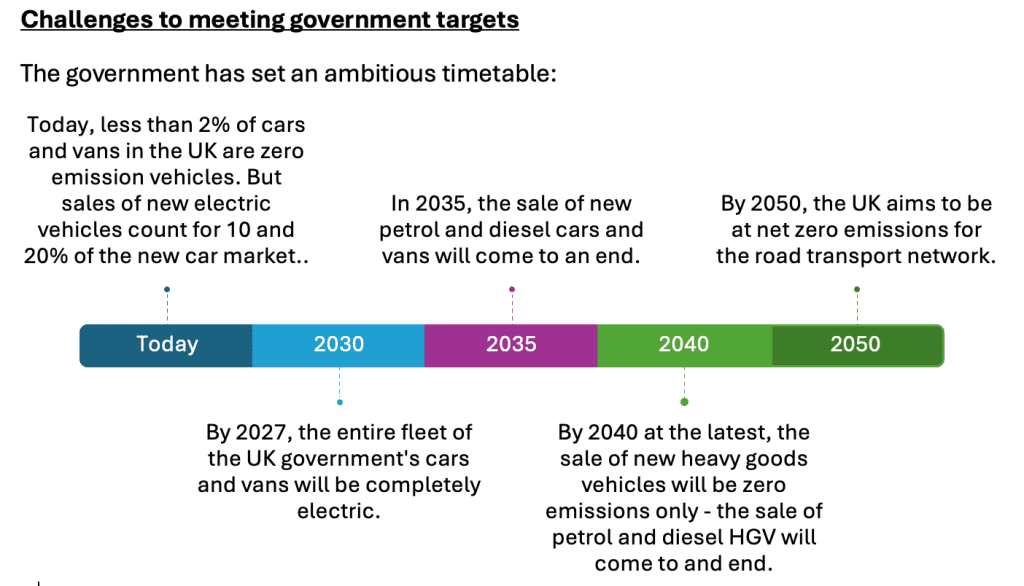
The government has set an ambitious timetable:
It faces a number of challenges in achieving its targets. Perhaps first among these is the need for a much more extensive charging infrastructure across the UK and (from a commercial point of view) beyond the UK. For businesses that rely on the ability to make long distance trips quickly, a network of fast chargers is essential.
There are currently around 66,000 fast chargers in the UK, of which 13,000 are “rapid” chargers (very high speeds over 50kW). The government has proposed a network of 300,000 by 2030 but some commentators consider this will not be enough. Other challenges include the loss of fossil fuel taxes (the government taxes petrol and diesel but does not tax electricity in the home), addressing the entire life cycle of CO2 emissions (factors of production and so on), and carbon emissions that today are not accounted for with emissions from oil and so on.
The cost of electric vehicles is sometimes highlighted as a challenge to change the transportation methods of ordinary people. There is no doubt that new electric vehicles cost much more to buy and, for some drivers, tyres wear faster and therefore cost more over the car’s life cycle. In the case of a new expensive EV, a driver may not recover costs until it reaches as much as 100,000 miles.
That said, electric vehicles are much cheaper to run. Costs per mile driven are very low with servicing costs (“servicing costs”) also lower. The brake pads don’t wear off as quickly due to the reproducible braking of EVs. If you charge your EV on an overnight tariff (eg Octopus Go), you’ll recover costs at around 55,000 miles, or 45,000 miles if you charge from solar energy (via solar panel use) alone . Finally, second-hand cars will pay off significantly faster than this (perhaps almost immediately – the costs of second-hand heavier cars are very competitive at the moment, with terrible good deals in the second-hand market).
In my experience of working with local authorities in Wales, some are well ahead of net zero targets while others are well behind (possibly a good reflection of society as a whole). For those behind the issue seems less financial and instead has to do with a lack of conviction about government targets, perhaps stemming from an expectation that these goalposts could shift.
If you’re a community group looking to reduce your carbon footprint, make green transport easier and accessible, or look into other ways of becoming more sustainable and resilient, get in touch to see how an Egin Peer Mentor could help you today.
Comments are closed.