


Prior to becoming an Egin Peer Mentor, Elfed worked for the Energy Saving Trust and the Welsh Government, supporting local authorities and other organisations in their efforts to decarbonise transport. Here he discusses how the UK’s transport sector might meet the 2050 zero carbon target.

The UK government has a legal commitment to achieve net zero by 2050. To achieve this it has adopted a number of policies and proposals for decarbonising all sectors of the economy including the transport sector.
We are yet to hear how these policies and proposals will change under the new Labour government at Westminster, but for now the current policies remain in place.
What can community groups do?
Given that Egin empowers groups and organisations to make changes at a community level, I will start with some thoughts on what community groups can do to help with the move towards decarbonisation:
- First, if you have vehicles, think about how practical it would be to switch them to electric vehicles.
- For any staff you employ, are there ways to support them in their desire to run electric vehicles—through a salary sacrifice scheme, for example, or by providing charging points in a work setting for those workers who do not have off-street parking or a place to charge an electric vehicle in their homes.
- Maybe have parking in the town centre or a building with solar panels. Could you offer a lower cost charging facility for local people (and staff) in your car park and through your solar syystem?
- Again, thinking about the wider community, are you in a position to start, or contribute to, a car club or community transport programme based on electric vehicles?
- While helping those with limited transport options, this also has the advantage of giving people with the ability and interest to invest in a vehicle the opportunity to try out an EV.
- By choosing greener vehicle options you are sending a message to the community about your priorities and also modelling more sustainable transport practices.
How could the transport sector be decarbonised?
There are a number of different ways in which the transport sector could be decarbonised. We can focus on how we run vehicles (moving away from petrol and diesel to less carbon-intensive fuels); we can focus on how we produce vehicles (to reduce carbon load during production); and we can focus on changing consumption patterns so that fewer of us are in cars (more cycling, walking, and public transport).
The UK government’s plans reflect a preference for the former approach, focusing efforts on moving away from fossil fuel vehicles (ICE) to electric vehicles (EVs). UK Government targets in the transport sector include:
- end the sale of all fossil fuel vehicles (except HGV) by 2035
- end sales of HGV vehicles using fossil fuels no later than 2040
- ensuring that all government car and van fleets will be fully electric by 2027
These plans envisage the same pattern of transport use as today but with electric vehicles rather than diesel and petrol. The Welsh government’s plans appear to focus on changing existing patterns of use (rather than preferring to change car type on its roads) by:
- making active travel a choice for short trips
- Improving integrated public transport – trains and buses
- Transport limited to 20mph in residential areas
- Implementing an electric vehicle charging strategy to address uranium charging deficiencies beyond the home
The Welsh Government’s targets for road transport can be described in accordance with a “avoid-change-improve” framework: that is, avoid unnecessary travel (by working remotely, for example), move to less carbon-intensive methods, and improve energy efficiency.
Why Electric Vehicles? How do they reduce carbon?
Emissions are measured in kilograms of carbon dioxide equivalent, or “kgCO2e”. (The “equivalent” here refers to the fact that there are other gases besides carbon dioxide that cause climate change and this measure allows us to include all these gases in a useful shorthand). Petrol emits 2.1kgCO2e per litre, and diesel 2.51 kgCO2e per litre. Car size, mile-per-gallon and so on affect efficiency but on average cars emit 0.27332 kgCO2e per mile.
Electric vehicle emissions also depend on size, efficiency and so on. Ordinary electric vehicles could travel 3 miles per kilowatt hour of electricity . One kilowatt of grid electricity emits 0.207047 kgCO2e . Ordinary electric vehicles should emit about 0.0691 kgCO2e per mile travelled, about a quarter of the average fossil fuel car, and if you charge the car off solar panels on your buildings, this effectively becomes 0 kgCO2e per mile.
This sounds very positive, and indeed it is. But we should remember that electric vehicles are not carbon-free. In fact, currently, the carbon cost of building new electric vehicles is greater than building a petrol or diesel car.
“Carbon refueling” periods are the time it takes for an EV to emit less carbon than a petrol vehicle. Due to its larger production emissions – varying by model – there is a period of time during which the emissions of an electric vehicle exceed those of a petrol or diesel vehicle.
But, when used every mile traversed in an electric vehicle (as opposed to a petrol vehicle) the emissions savour, and a good rule of thumb is that electric vehicles save carbon (when compared to a fossil fuel vehicle) after about 12-15,000 miles (the average UK driver travels around 7400 miles a year). If this sounds complicated, check out the graph below.
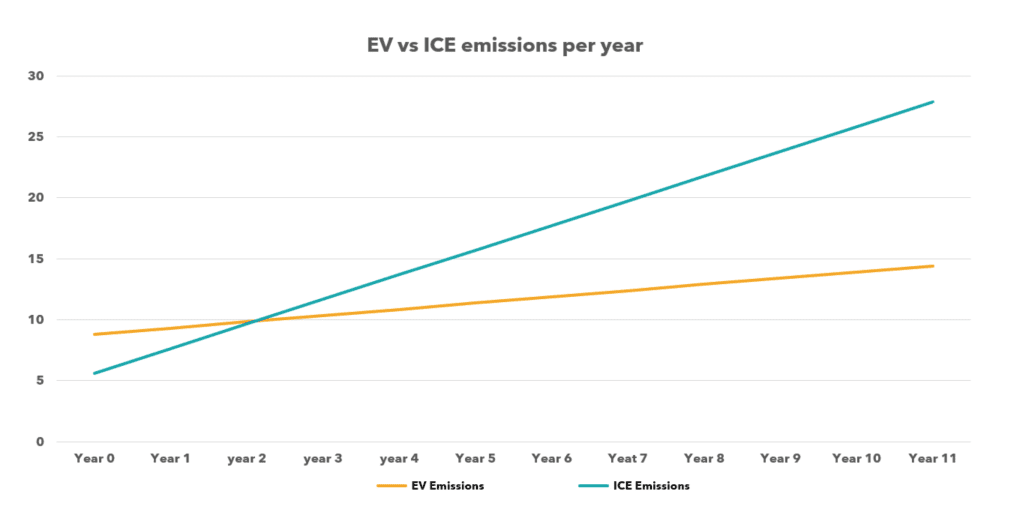
These figures are based on:
- Emissions generated by the construction of an electric vehicle of 8.8 tonnes kgCO2e
- Fossil fuel car manufacturing emissions of 5.6 tonnes kgCO2e
- Both cars drive 7400 miles a year – the current average distance cars in the UK traverse each year
It’s worth considering “efficiency behind the wheel” when looking at these figures. When counting petrol and diesel emissions, we measure what comes out of the back of the vehicle while driving it. Emissions during the removal of oil from the ground, processing it to be suitable for use in vehicles, and the transport of fuel such as petrol and diesel to the petrol station are not included in this emissions figure.
Electric vehicle emissions are “Well to Wheel” – from a power station or wind farm to actual road use. Therefore, EV emissions are lower than those shown in the graph, compared to the actual emissions of a vehicle running on fossil fuels.
This blog will be continued in part 2
Comments are closed.